
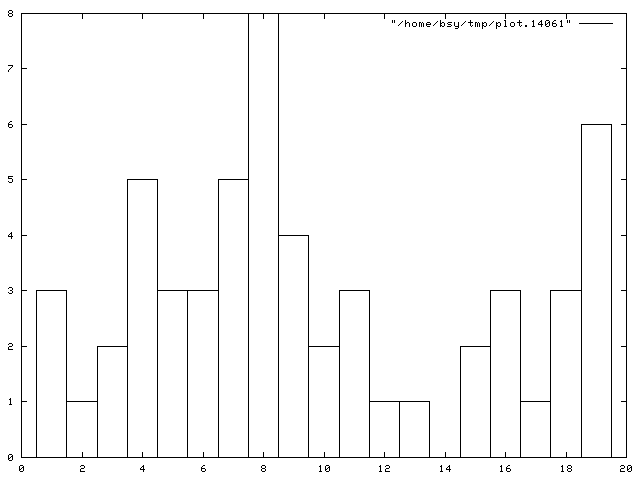
Grade statistics:
56 students handed in assignment 5.

assignment 5 as a whole: mean  49.2196
                         stdev 27.4466

w/o late adjustment: mean  51.3929
                     stdev 27.9334

Excluding all-zero scores:

assignment 5 as a whole: mean  49.2196
                         stdev 27.4466

w/o late adjustment: mean  51.3929
                     stdev 27.9334

Per-problem statistics:

Num  1:  mean  31.875000
         stdev 9.662266
Num  2:  mean  3.660714
         stdev 2.214214
Num  3:  mean  14.107143
         stdev 19.344322
Num  4:  mean  1.750000
         stdev 3.641281


Per-problem statistics, omitting zero grades:

Num  1:  mean  31.875000
         stdev 9.662266
Num  2:  mean  5.000000
         stdev 0.000000
Num  3:  mean  30.384615
         stdev 17.646261
Num  4:  mean  8.909091
         stdev 1.928473
Due Nov 30.
Download this code and translate to MIPS assembly code following the instructions therein.
#define	DEBUG	0

/*
 * "compatibility" layer to simulate SPIM syscalls.  you can safely ignore
 * this code to "Start of assignment code".
 */
#include <stdio.h>

void	print_int(int	a0)
{
	printf("%d",a0);
}

void	print_float(float	f12)
{
	printf("%f",f12);
}

void	print_double(double	f12)
{
	printf("%f",f12);
}

void	print_string(char	*a0)
{
	printf("%s",a0);
}

int	read_int(void)
{
	int	v0;
	scanf("%d",&v0);
	return v0;
}

float	read_float(void)
{
	float	f0;

	scanf("%f",&f0);
	return f0;
}

double	read_double(void)
{
	double	f0;

	scanf("%lf",&f0);
	return f0;
}

void	read_string(char	*a0,
		    int		a1)
{
	fgets(a0,a1,stdin);
}

/* sbrk/exit implemented in libc */

/*
 * Start of assignment code
 */

/*
 * Assignment 5.
 *
 * In-fix calculator.
 *
 * Your job is to hand translate this to MIPS assembly and run this using
 * the SPIM simulator.  Your code should include the usual comments /
 * documentation.
 *
 * We do operator precedence parsing.  The expression grammar is
 *
 * START -> expr
 *
 * expr -> expr '+' term | term
 *
 * term -> term '*' factor | factor
 *
 * factor -> number | '(' expr ')'
 *
 * number -> [0-9]+
 *
 * Your MIPS assembly code should be a direct translation of this
 * "2-banger" calculator.  The conditional compilation symbol DEBUG
 * should have the value 0, so you should not generate any DEBUG code.
 * You may, however, wish to include that in a test version to aid you
 * in debugging your assembly language translation.
 */

struct expr {
	struct expr	*a,*b;
	int		op, val;
};
#define	OP_NUM		0	/* only val used */
#define	OP_PAREN	1	/* only a used */
#define	OP_ADD		2	/* both a and b used */
#define	OP_MULT		3	/* both a and b used */

#define		LINE_LENGTH	256
#define		MAX_ELTS	32

struct expr	e_space[MAX_ELTS];
struct expr	*e_unused[MAX_ELTS]; int	e_ix;

void	out_of_memory(void)
{
	print_string("Out of memory!\n");
	exit(0);
}

void	corrupt_data_structure(void)
{
	print_string("Internal error: data structure corrupt!\n");
	exit(0);
}

void	allocator_init(void)
{
	int	i;

	for (i = 0; i < MAX_ELTS; i++) {
		e_unused[i] = &e_space[i];
	}
	e_ix = MAX_ELTS;
}

struct expr	*e_alloc(void)
{
	if (e_ix == 0) {
		out_of_memory();
	}
	--e_ix;
	e_unused[e_ix]->a = 0;
	e_unused[e_ix]->b = 0;
	return e_unused[e_ix];
}

void	e_free(struct expr	*ep)
{
	e_unused[e_ix++] = ep;
}

void	free_expr(struct expr	*ep)
{
	if (ep) {
		free_expr(ep->a);
		free_expr(ep->b);
		e_free(ep);
	}
}

#if	DEBUG
void	print_expr(struct expr	*ep)
{
	if (!ep) {
		print_string("NULL\n");
	} else {
		switch (ep->op) {
		case OP_NUM:
			print_int(ep->val);
			break;
		case OP_PAREN:
			print_string("(");
			print_expr(ep->a);
			print_string(")");
			break;
		case OP_MULT:
			print_string("(");
			print_expr(ep->a);
			print_string("*");
			print_expr(ep->b);
			print_string(")");
			break;
		case OP_ADD:
			print_string("(");
			print_expr(ep->a);
			print_string("+");
			print_expr(ep->b);
			print_string(")");
			break;
		default:
			corrupt_data_structure();
		}
	}
}
#endif

char	expr_buf[LINE_LENGTH];
int	expr_ix;

struct expr	*read_num(void)
{
	int		val = 0, ch, got_num = 0;
	struct expr	*exprp = 0;

	while ((ch = expr_buf[expr_ix]) && ch != '\n') {
		switch (ch) {
		case '0': case '1': case '2': case '3':
		case '4': case '5': case '6': case '7':
		case '8': case '9':
			val = 10 * val + ch - '0';
			got_num = 1;
			expr_ix++; /* consume the digit */
			break; /* break from switch; continue while */
		default:
			goto done;
		}
	}
 done:
	if (got_num) {
		exprp = e_alloc();
		exprp->op = OP_NUM;
		exprp->val = val;
	}
#if	DEBUG
	else {
		print_string("read_num: no number found\n");
	}
#endif
	return exprp;
}

struct expr	*read_expr(void);	/* forward declaration */

struct expr	*read_factor(void)
{
	int		ch;
	struct expr	*exprp = 0, *paren;

	ch = expr_buf[expr_ix];
	switch (ch) {
	case '0': case '1': case '2': case '3':
	case '4': case '5': case '6': case '7':
	case '8': case '9':
		return read_num();
	case '(':
		expr_ix++; /* consume open parenthesis */
		paren = read_expr();
		ch = expr_buf[expr_ix];
		if (ch == ')') {
			expr_ix++; /* consume close parenthesis */
			exprp = e_alloc();
			exprp->op = OP_PAREN;
			exprp->a = paren;
			return exprp;
		}
#if	DEBUG
		print_string("No matching close parenthesis\n");
		print_expr(paren);
		print_string("\n");
#endif
		free_expr(paren);
		return 0;
	}
	return 0;
}

struct expr	*read_term(void)
{
	struct expr	*a, *b, *exprp;
	int		ch;

	exprp = 0;
	a = read_factor();
	if (!a) return 0;
	while (expr_buf[expr_ix] == '*') {
		expr_ix++; /* consume the times */
		b = read_factor();
		if (!b) {
#if	DEBUG
			print_string("read_term: Times nothing!\n");
			print_expr(a);
			print_string("\n");
#endif
			free_expr(a);
			return 0;
		}
		exprp = e_alloc();
		exprp->op = OP_MULT;
		exprp->a = a;
		exprp->b = b;
		a = exprp; exprp = 0;
	}
	return a;
}

struct expr	*read_expr(void)
{
	struct expr	*a, *b, *exprp;
	int		ch;

	exprp = 0;
	a = read_term();
	if (!a) return 0;
	while (expr_buf[expr_ix] == '+') {
		expr_ix++; /* consume the plus */
		b = read_term();
		if (!b) {
#if	DEBUG
			print_string("read_expr: Plus nothing!\n");
			print_expr(a);
			print_string("\n");
#endif
			free_expr(a);
			return 0;
		}
		exprp = e_alloc();
		exprp->op = OP_ADD;
		exprp->a = a;
		exprp->b = b;
		a = exprp; exprp = 0;
	}
	return a;
}

struct expr	*read_expression(void)
{
	int		i;
	struct expr	*exprp;

	expr_ix = 0;
	read_string(expr_buf,LINE_LENGTH);
	exprp = read_expr();
	if (expr_buf[expr_ix] != '\n') {
		print_string("Warning: excess characters ignored:\n");
		print_string(expr_buf);
		for (i = 0; i < expr_ix; i++) {
			print_string(" ");
		}
		print_string("^\n");
	}
	return exprp;
}

int	eval_expr(struct expr	*e)
{
	if (!e) corrupt_data_structure();
	switch (e->op) {
	case OP_NUM:
		return e->val;
	case OP_PAREN:
		return eval_expr(e->a);
	case OP_ADD:
		return eval_expr(e->a) + eval_expr(e->b);
	case OP_MULT:
		return eval_expr(e->a) * eval_expr(e->b);
	default:
		corrupt_data_structure();
	}
}

void	main(void)
{
	struct expr	*e;
	int		i;

	allocator_init();

	while ((e = read_expression()) != NULL) {
#if	DEBUG
		print_string("Entered: "); print_string(expr_buf);
		print_string("Parsed: "); print_expr(e);
		print_string("\n");
#endif
		print_int(eval_expr(e));
		print_string("\n");
		free_expr(e);
	}
	print_string("syntax error:\n");
	print_string(expr_buf);
	for (i = 0; i < expr_ix; i++) {
		print_string(" ");
	}
	print_string("^\n");
}
bsy+cse30.f99@cs.ucsd.edu, last updated
email bsy.