The files are
The first driver is just the same as that used in assignment 5. The second driver tests thread priority. The third driver tests dynamic thread creation. You'll have to write your own driver to test locking. Rough C code for testing the lock code is available.Sample output from running my sample solution (not provided) with the above drivers is now available. Output from an implementation that schedules the threads slightly differently, with the same set of drivers, is also available.
You may also want to look at the sample solution for assignment 5 as another starting point.
We tested with the following drivers:
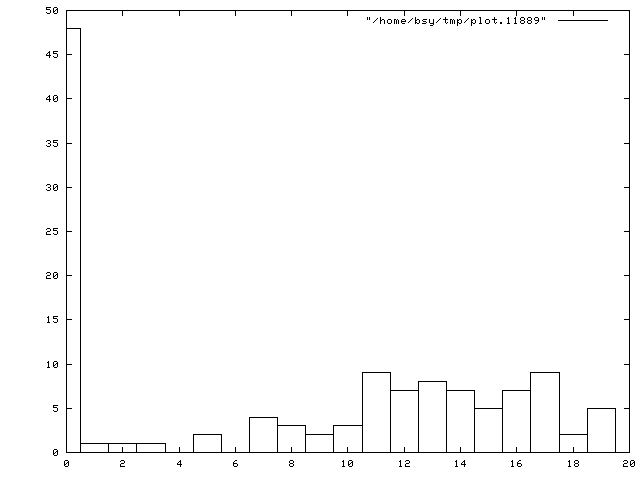
The grade distribution is
The grade distribution is
124 students handed in assignment 6.

assignment 6 as a whole: mean  39.602
                         stdev 35.3735

w/o late adjustment: mean  40.25
                     stdev 35.3363

Excluding all-zero scores:

assignment 6 as a whole: mean  63.7747
                         stdev 21.7589

w/o late adjustment: mean  64.8182
                     stdev 20.4538

Per-problem statistics:

Num  1:  mean  10.201613
         stdev 9.783940
Num  2:  mean  3.991935
         stdev 6.155899
Num  3:  mean  6.000000
         stdev 8.041224
Num  4:  mean  8.790323
         stdev 8.361079
Num  5:  mean  11.266129
         stdev 9.672132


Per-problem statistics, omitting zero grades:

Num  1:  mean  18.880597
         stdev 3.646803
Num  2:  mean  8.684211
         stdev 6.456760
Num  3:  mean  14.307692
         stdev 5.943770
Num  4:  mean  15.138889
         stdev 4.928110
Num  5:  mean  19.136986
         stdev 2.877951
One thing we looked for was the ability for the threads package to be used by a long-running multithreaded program. If your dynamic thread creation just extended the thread table, this means that after 256 threads are created/initialized and then exited, the thread table fills up and the thread package will crash. It is much better to scan the table for an unused slot, where some previous thread had run and completed.

bsy+www@cs.ucsd.edu, last updated
